A Blessed Opportunity to Serve Children with Cerebral Palsy
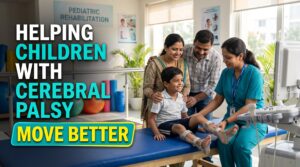
Recently, we have been blessed to treat Cerebral Palsy (CP) children from KEM Hospital where I am an honorary consultant Pain Physician for paediatric department there. I say blessed because I have been associated with CP children as a paediatric anaesthesiologist at Wadia Children’s Hospital from 1982 to 2002.
I have always found CP children to be very special. All children are special and are a source of joy but in the context of CP kids, I mean that they somehow bring not just happiness but a sense of beatitude to their surroundings, despite their own suffering.
Even though they are themselves abnormally developed, with deformities and probably have some pain as well, they are always smiling and happy.
I always used to think that they were indeed children of God.
A Teenager Who Loved School
I am saying this based on my interaction with CP children of all ages from infants to teenagers. To give you an example, I had to anaesthetize a teenager for a major corrective surgery because he had severe deformities at hips knee and ankle which made his movements very awkward, so I imagined (wrongly) that the other children would probably laugh at him, but when I asked him “how do you like school” and his answer was an exuberant “I love it!! I love to go to school where I can have fun with my friends! These children always see the best in their surroundings and in return give their best to their surroundings.
Parents Who Feel Blessed
It has been my experience that the parents of CP children also feel blessed even though they have to take care of these older kids as if they were infants and serve them for years together well into adulthood and further.
I remember a mother of a CP child, who had been bedridden for 12 years because of his problems and would be crying piteously, but once in a while, he would give a beatific smile to his mother.
This mother told me “I love, both my sons, (the younger boy was normal) but Roshan came into my life to teach me a higher lesson. “I am a wealthy woman who always had everything in life, loving parents, loving husband, so I thought I had a good life and then Roshan was born. In taking care of him, I realized that my life became so much enriched because GOD came to me in this form.
My second son also is such a lovely boy, so kind and considerate because he has learnt from childhood to take care, give unconditional love and affection to his elder brother”. This is just one of the several different versions of the same sentiment that I have heard from hundreds of CP parents over the years.
Introducing the Ashirvad Approach at KEM Hospital
When I gave an introductory lecture at KEM Hospital on “Common Paediatric Pain Conditions: Ashirvad Approach to Their Resolution,” I intentionally kept a good chunk of time to focus on how ultrasound-guided dry needling can help correct deformities in children with cerebral palsy.
I included slides showing CP children before and after ultrasound-guided dry needling (USGDN) treatment over the years.
This lecture was attended by an orthopaedic surgeon who started sending the cerebral policy children to the KEM paediatric Pain OPD. I saw these children to diagnose the muscles causing their deformities and then USGDN addressed the issues.
USGDN for CP deformities—a pilot approach not previously explored globally.
Early Clinical Outcomes with USGDN in CP Children
Although I had previously administered USGDN to children with cerebral palsy, these instances were sporadic, with treatments provided intermittently as CP patients sought care only occasionally.
I had discussed my results with USGDN with multiple physicians specializing in pediatric cerebral palsy, but referrals had been infrequent.
Consequently, I was unable to form a comprehensive assessment of the efficacy of USGDN in treating cerebral palsy.
But after this talk, the referrals have been consistent because the first two babies did very well. (figures of Arhan and Ali)

After just three or four needling sessions, these babies showed such significant improvement compared to a year of regular physiotherapy, that their parents were thrilled.

The physiotherapists, and orthopedic surgeon were all pleasantly surprised and impressed as well.
Revisiting the Science: My Journey into Muscle Anatomy
After observing the remarkable outcomes of ultrasound-guided dry needling (USGDN) in CP children, I felt compelled to evaluate the underlying reasons and mechanisms for its unexpected efficacy.
This situation mirrored my experience in the early 2000s, when I had undertaken a similar evaluation of conventional blind dry needling methods.
Around 2003-4, I was practicing an extended form of blind dry needling. The outcomes were so positive that I decided to study muscle was anatomy more deeply to better explain these excellent results.
Over six months, I undertook extensive anatomical dissection to advance my knowledge of muscle structures across the back, limbs, abdomen, thorax, and head and neck regions.
I quickly realized that my comprehension encompassed less than ten percent of the complexities involved in muscular anatomy despite having taught and maintained an active academic role as an anaesthesiologist. I spent so much time in the cadaver lab that Dr Rakhi.
More, who was the anatomy lecturer assigned to me to guide my dissection was also surprised that I was going into so much detail. She reassured me that such depth is seldom covered in undergraduate medical education, which typically allocates only one and a half years to basic anatomical studies. She further explained that detailed understanding of intricate back and neck muscle anatomy is usually acquired during postgraduate MD examinations.
This insight alleviated my initial concerns regarding my perceived lack of knowledge, revealing that limited exposure to advanced muscle anatomy during undergraduate training is common among physicians. My intensive experience in the cadaver laboratory illuminated that muscles do not function independently; rather, they operate as agonists, antagonists, synergists, or facilitators depending on the movement involved. Muscle groups may oppose each other during certain actions but collaborate during others—for instance, while the tibialis anterior and tibialis posterior perform opposite roles in ankle flexion and extension, they work jointly to invert the ankle. This principle applies throughout the body, highlighting the complexity of muscle kinesiology.
Appreciating this intricate interplay transformed my clinical practice replacing the blind dry needling with the much more precise science of USGDN, enabling accurate visualization, identification, and targeted treatment of muscles using ultrasonography.
Another key distinction is that blind dry needling works only on myofascial trigger points, while USGDN treats both the entire muscle—including its trigger points—and related muscles at the same time. This makes USGDN a very effective and accurate science guided by ultrasonography, which also helps us to avoid important structures and steer clear of blood vessels, nerves, the pleura , lungs, the peritoneum and the gut because during sonography, all these structures are directly in our vision and we can stay above the structures and address only the muscles. This adds a tremendous safety to the procedure, which can then address all the muscles as necessary at will however deep they may be situated.
Thus, It was this quest for an explanation of USGDN efficacy that significantly enhanced my understanding of chronic pain mechanisms in 2003-4. Two decades later, I am witnessing a similar scenario with children who have cerebral palsy, and the outcomes are truly remarkable—well beyond what we had anticipated. This surprisingly high success rate seems to be due to the fact that children’s muscles, much like new cars in excellent condition, respond very precisely to needling treatments unlike the adult muscle, which appears to be less responsive. Notably, outcomes that typically require five sessions in adults may be achieved in a single session for children. This is not to say that these children don’t need many sessions, they do, but after each session, older children who are able to articulate their experiences consistently report a noticeable improvement in ease of movement following each USGDN session. In the pre-verbal children, parents notice the difference immediately and of course physiotherapists who are working with them regularly notice rapid improvements as well. They’ve shared these observations with us, highlighting that the child benefits from noticeable correction of deformities with each USGDN session and easier movement. The Physiotherapist’s job becomes much easier and, in many cases, corrective surgery may be avoided. While it’s still early, this is my observation from treating 10 children so far.
Addressing Post-Surgical Fibrosis and Stiffness
Children who have had surgery often develop significant fibrosis around the scar due to collagen formation during healing. This process continues for up to 18 months, making the scar tougher and the underlying muscles stiffer.
The stiffness of post-surgical fibrosis also shows improvement with USGDN treatment, becoming more flexible and enabling greater mobility.
In adult patients, our findings indicate that following USGDN, muscle tissue demonstrates regeneration within scar tissue in individuals experiencing post-surgical pain.
Thus, USGDN appears to be a very promising treatment to reverse the movement difficulties, stiffness, dystonia, and deformities in CP children, even those who continue to have problems despite corrective surgery performed years ago.
Optimizing Botulinum Toxin with USGDN
Botulinum toxin doses can be reduced by optimising its relaxant effect with USGDN.
A check USGDN session can be used to determine the minimal dose of toxin required for best effects. The muscle’s stiffness, felt through the needle, guides dosing—softer muscles require less botulinum toxin.
Additionally, ultrasonography assists in differentiating normal muscles from spastic muscles.
Normal muscles typically do not elicit a response or cause discomfort upon needle insertion, whereas spastic muscles often exhibit observable reactions, such as local twitch reflexes and occasional dystonic movements.
Highly reactive muscles require larger doses of Botox. A normal muscle shows no reaction to needle insertion which is also painless, but a spastic muscle exhibits visible reactivity.
We keep seeing local twitch reflexes and sometimes frank dystonic movements inside the muscle, which would not be obvious to the naked eye. The greater the muscle reactivity, the higher the dosage of Botox required.
Observations like operator hand “feel” and visualized sonographic muscle responses help guide precise botulinum toxin injections, allowing 50 units to achieve the effect of 100 or more units. This is an approximate estimate based on adult data and applies to children with CP.
All in all, our work with CP children is highly promising, encouraging and very heartening not just for the parents, but to the attending doctors as well. The happiness of watching a child move freely, jump and dance after struggling to walk is truly uplifting— a feeling that’s hard to describe, like the satiety equivalent of a spoonful of sugar. Everyone at Ashirvad is grateful for the opportunity to explore the fantastic potential of USGDN in CP children.