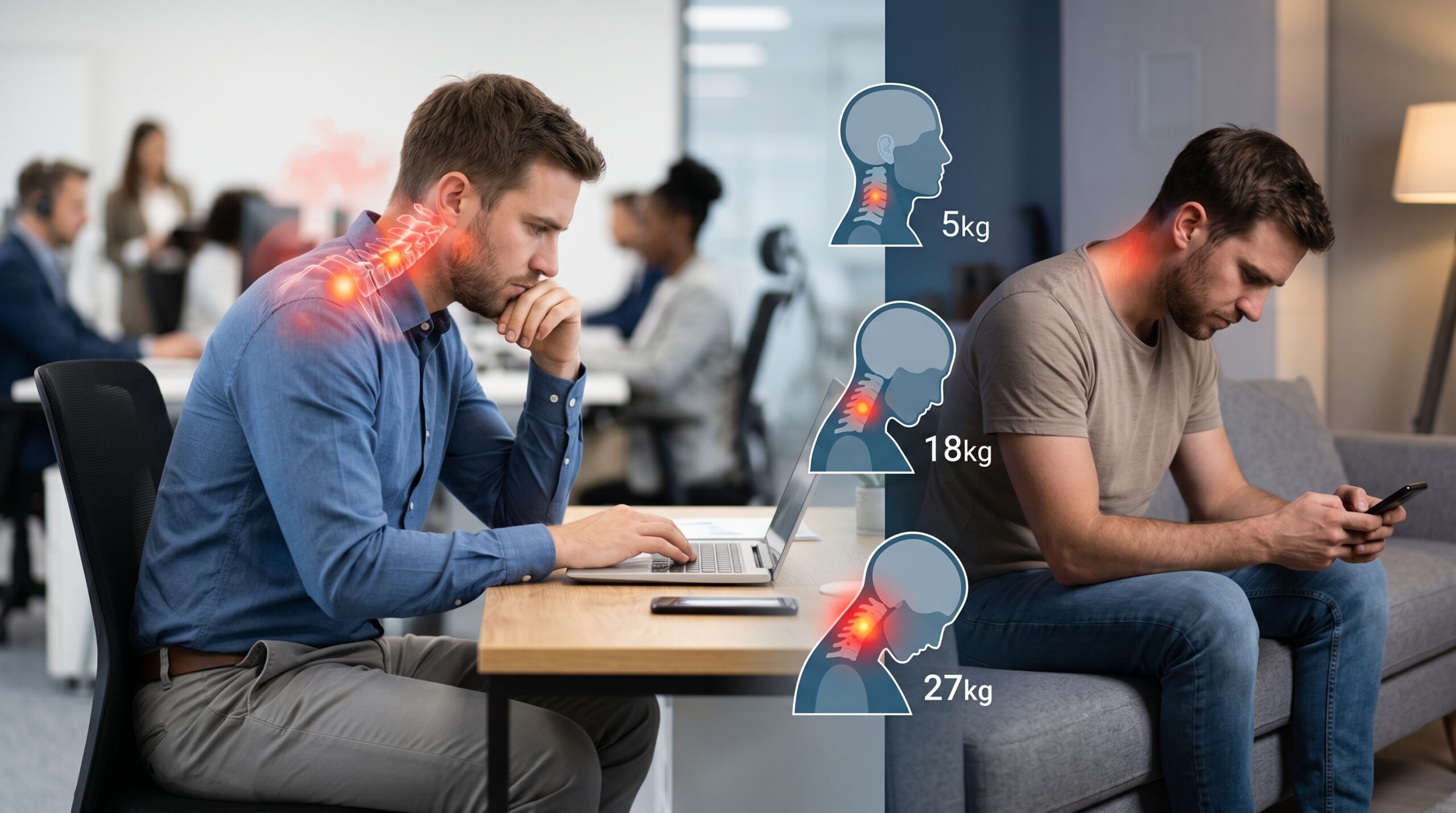
We live in an era of unprecedented convenience, but our bodies are paying a steep price for it. A generation ago, chronic neck and back pain were primarily viewed as wear-and-tear conditions of older age, or the result of acute traumatic injuries. Today, our waiting rooms are increasingly filled with young corporate professionals in their 20s, 30s, and 40s, all presenting with the exact same complaint: a persistent burning, dull or throbbing ache at the base and nape of the neck extending to the shoulder sometimes radiating up the neck into the head to become tension type headaches or migraine . Alternatively it may spread down along the shoulder blade or into the shoulder down the arm and in chronic cases down into the back .
This isn’t a viral outbreak or a genetic anomaly. It is a man-made crisis of posture, born directly out of the daily routine of the modern corporate workforce.
Consider the typical day of a modern corporate professional.
[9:00 AM – 6:00 PM] [6:30 PM – 11:30 PM]
Corporate Desk Work ───> Recreational Scrolling
(Slouched Over Laptop) (Looking Down at phone)
The day begins by sitting for eight to ten hours at a desk, shoulders rounded, head jutting forward toward a computer monitor or laptop. Under intense project deadlines, ergonomics are quickly forgotten.
When the workday ends, the physical strain does not. During the commute home and throughout the evening, professionals transition immediately to their secondary screens. We look down at our smartphones, mindlessly swiping through social media feeds, catching up on messages, or streaming videos.
The biological reality is that our bodies never leave the workplace. The cervical spine remains under continuous, unyielding mechanical stress from morning until bedtime.
The Biomechanical Math: Why Your Head Feels So Heavy
To understand why this lifestyle causes such severe pain, we have to look at the physics of the human frame.
The human head is surprisingly heavy, weighing approximately 4.5 to 5.5 kilograms (10 to 12 pounds) in a neutral, perfectly upright position (Alsiwed et al., 2021). In this neutral alignment, the cervical spine, supported by surrounding muscles and ligaments, is beautifully engineered to distribute this weight evenly. This is remarkable if you consider how quickly our hand or arm muscles get tired if we were to hold up a weight of even 1 kg against gravity. Nature allows considerable additional latitude in allowing the head to tilt forward to focus on work for a few hours at a time but not for the whole day at work and then the scrolling.
However, for every inch you tilt your head forward and downward to look at a screen, the relative weight of your head increases exponentially due to the physics of lever principle.
- At a 15-degree forward tilt, the head behaves as if it weighs roughly 12 kgs (27 lbs).
- At a 30-degree angle, that load increases to about 18 kgs (40 lbs).
- At a 60-degree angle—the standard posture adopted when looking down at a smartphone in your lap or hands—the gravitational pull forces your cervical spine to support an astonishing 27 kgs (60 lbs) of pressure.
Imagine carrying a 25-kilogram sack of cement on the back of your neck for several hours every single day.
The muscles of your upper back and neck—specifically the trapezius and levator scapulae—must contract constantly to keep your head from falling forward. These muscles were originally designed by nature for 4 legged animals where all the 4 limbs are placed on the ground for an utterly stable posture that allows swift running, leaping etc. By adopting the upright posture, humans gained the advantage of surveying the terrain from a height and an extremely versatile forelimb but the shoulder girdle muscles paid the price and showed degenerative changes with advancing age. But in the contemporary lifestyle with screen obsession they pay a heavy price over time, because constant contraction of these muscles leads to micro-tears, severe muscular fatigue, localized inflammation, and myofascial pain syndrome (painful muscle knots) with the resultant pandemic of neck and shoulder pains, migraine, back pain etc.
What the Data Tells Us: A Global and Local Crisis
This is no longer a niche issue; the numbers are staggering. Musculoskeletal disorders have become a dominant global health crisis, with neck pain tracking as one of the leading causes of years lived with disability worldwide (Al-Shalalfeh, 2025).
Recent clinical and cross-sectional studies emphasize how deeply digital dependency correlates with physical dysfunction:
The Corporate & Student Baseline: Epidemiological data reveals that between 48% and 78% of young adults and professionals using digital devices frequently report varying degrees of neck pain (Al-Shalalfeh, 2025; Dong, 2024).
The Indian Context:
Studies focused on the Indian population reveal that the prevalence of Text Neck Syndrome sits heavily between 25% and 47% among regular device users (Mussa, 2025). In localized regional surveys of young adults, up to 75% of participants reported experiencing the hallmark symptoms of Text Neck, including direct neck pain (60%), shoulder discomfort (50%), and tension headaches (55%) (Ahari, 2020). Indians have added factors of vitamin B12 deficiencies because of vegetarianism and pollution interfering with ultraviolet ray availability for Vit D3 absorption etc.
The Dose-Response Effect:
Research confirms a clear dose-response pattern; individuals who log more than 4 to 6 hours of smartphone use per day exhibit significantly higher scores on the Neck Disability Index (NDI) compared to lighter users (Ahari, 2020; Salameh et al., 2024).
How the Pain Cascades: Beyond a Simple Muscle Ache
If Text Neck Syndrome were just a matter of sore muscles, a simple massage or a hot compress might suffice. Unfortunately, prolonged forward head flexion triggers a destructive cascade throughout the entire spine (Alsiwed et al., 2021):
- Muscular Fatigue – Postural muscles stretch and weaken; chest muscles tighten. Generalized stiffness, burning ache across shoulders.
- Structural Shift – Loss of the natural curve (cervical lordosis), leading to a straight or reversed curve. Reduced range of motion; chronic, localized structural pain.
- Accelerated Degeneration – Early wear-and-tear paired joints between adjacent vertebrae called facets and on intervertebral discs due to uneven loading. Disc bulges, herniations, and development of bone spurs.
- Neurological Compression – constant spasm of paravertebral muscles causes pressure on the discs causing them to herniate, the vertebrae to develop bony spurs which press against existing cervical nerve roots. Radiculopathy is pain going down the limb in the distribution of the compressed nerve with constant pain, shooting pain, numbness, or tingling down the arms and fingers.
Furthermore, the constant pulling of neck muscles at the base of the skull frequently triggers cervicogenic headaches – headaches that start in the neck and radiate to the forehead and behind the eyes.
Reclaiming Your Spinal Health
You do not necessarily have to quit your corporate job or throw away your smartphone, but you must change how you interact with them.
Elevate Your View
The single most effective change you can make is to bring your screens to eye level. Raise your external monitors. When using your phone, bring your hand up to your eyes rather than dropping your head to your lap.
Implement the 30-30 Rule
For every 30 minutes of seated desk work, take 30 seconds to look up at the ceiling, pull your shoulders back, and perform a gentle chin tuck (drawing your head straight back like a turtle, not tilting it down). This resets your posture and breaks the cycle of continuous muscle contraction.
Move Intermittently
Sedentary behaviour combined with low physical activity drastically exacerbates neck disability (Dong, 2024). Simple, daily neck and shoulder stretching combined with regular walks can significantly preserve thoracic spine and cervical mobility.
Even after taking care of ergonomics at the workplace, the pain may persist. For such pains we at Ashirvad Institute for Pain Management and Research have several treatments. We treat the whole patient rather than just their neck pain. We check vitamin levels, do lifestyle and stress management counselling, refer to gut health experts, psychologists where necessary and take care in general as well as specific treatments as follows.
Ultrasound Guided Dry Needling (USGDN) of the affected muscles. With the help of ultrasound we can see the muscles in real time and address the deepest layers of the neck and back muscles. After putting a needle in the muscle; the muscle goes into relaxation. Once all the muscles go into relaxation and are strengthened with physiotherapy, the pain disappears.
Ultra Low dose botulinum toxin injections under ultrasonography :
This is used to provide quick relief which makes the USGDN painless. Also the effect of the injections last for 5-6 months allowing the pain pathways to rest and recover. Since we always recommend USGDN after botulinum toxin injection, the effects of the injection become permanent provided the person adopts lifestyle changes like regular neck exercises, yoga and judicious screen use.
Fascia treatments; Fascia is the enveloping sheath of muscles that provides a flexible framework for muscles. It has been said that muscles of the body are actually one muscle poured into 600 sheaths that communicate with each other rather than 600 muscles with their fascial sheath. Ultrasonography has revolutionized fascia treatments which specifically target stiffness, and movement restrictions.
Physiotherapy, Yoga and Mindfulness practices
We have developed specific physiotherapy regimes using certain yoga practices which not only help to stretch the muscles but also strengthen them.
Your spine is the literal pillar of your health. Don’t let the modern lifestyle break it.