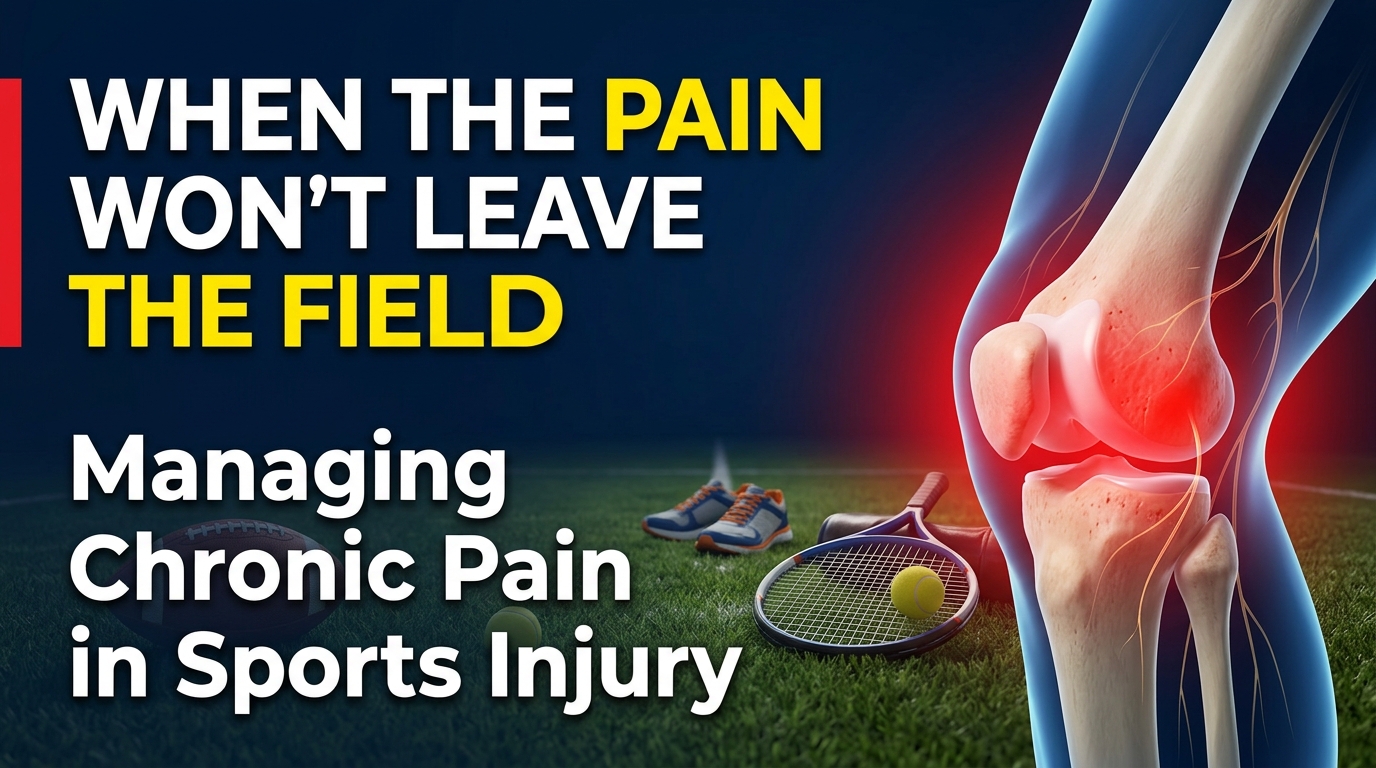
Most sports injuries follow a familiar script. Athletes are aiming for better and better performances and overextend their limits in trying to be supermen. And Tissues gets damaged as they will, with full blown expression of the 4 Components of inflammation , Rubor ( redness) dolor (pain flares) calor (warmth) and tumour (swelling). The athlete is advised rest anti-inflammatories and gentle guided physiotherapy and more ofen than not , unless there damage is beyond this control full recovery ensues within a predictable window the pain fades as healing completes.
But a significant minority of athletes — recreational and elite alike — find that the pain refuses to follow the script. The ultrasonography scan looks healed, the tissue has had time to recover, yet the pain persists, spreads, or returns with every attempt to train. This is where sports medicine hands the baton to pain management, and where the pain physician becomes a central member of the team.
This shift in thinking — from treating an injury as just a hiccough in the training process, to understanding that injuries require something more than just managing a pain experience — sits at the heart of the modern, multidisciplinary approach to sport injuries.
Below is a practical overview of how chronic pain develops in athletes and how it is best managed.
Acute vs chronic pain: when pain stops being a messenger
Acute pain is useful. It is largely nociceptive — a faithful alarm to draw attention to the need for a protection of injured tissue and enforces the rest needed for healing. Athletes, by temperament and training, are unusually good at ignoring this alarm, which is part of the problem.
The body has a tremendous capacity to absorb punishment and follows the principle “ the show must go on” The bodily responses to injury can be compared to a round bottomed doll that returns to straight position even after repeated pushes. But repeatedly ignoring the alarm signals in an attempt to be back at practice soon after an injury even though the body is sending messages of pain and stiffness is the main harbinger of pain becoming chronic (or persistent) when it lasts beyond the normal healing time, conventionally around three months.
Certain factors specific to the person like deficiencies of vitamins ( particularly D3 which is like a natural anti-inflammatory agent to help ready healing of microtears of muscle so common in athletes, B12 essential for healthy nerve sheaths loss of which leads to irritability ) minerals ( low levels of iron, magnesium) or an innate variants of normal muscle that predispose to injuries may pave the way for
At this stage the relationship between pain and tissue damage transforms from physiological (normal) to pathological ( abnormal, diseased). The nervous system itself changes to abnormality, the nerves of the pain pathway, carrying messages from injured part to spinal cord, ( the peripheral nervous system ) the spinal cord itself and the centres in the brain that receive pain signals to convey the sensation of pain to the mind and the emotional pathways that are intimately connected to the pain pathway all begin to change
– Peripheral sensitisation— injured tissues and collection of inflammatory mediators( chemicals produced by our defensive cells after an injury ) lower the firing threshold of local nociceptors( pain detectors). So the body avidly transmits pain signals
– Central sensitisation — the spinal cord and brain amplify and “rewire” pain signalling> Under normal circumstances there is a “Gate“ in the spinal cord that is semilclosed and will not open to let the pain signals travel to brain unless there is an overpowering barrage of pain signals. But when the nerves in the spinal cord get sensitized the gate opens and remains open . This rewiring is detrimental in that even a very small pain signal is perceived as being a severely painful. This has been compared to a speaker without a volume control. Even a low sound causes a “sound blare” or pain blare”
At this stage even a normal non-painful or even pleasant touch starts to hurt (allodynia) and painful ones hurt more (hyperalgesia.
– Nociplastic pain —is pain arising from altered central abnormal processing rather than ongoing tissue damage, is increasingly recognised as a driver of stubborn, widespread sports pain.
At this stage the abnormal rewiring of nerves from periphery through spinal cord to the brain creates a situation that favours pain to be felt in an exaggerated manner. From the normal “ show must go on “ policy it becomes “ show is impossible” – the round bottomed doll keeps returning to this abnormal “ just can’t handle pain “ situation.
The practical consequence is crucial: in chronic sports pain, the pain is often the disease, not merely a symptom. Chasing a structural “fix” on imaging frequently fails, because the structure is no longer the main problem. What need to be done is to restore the rouRound bottom doll toward normalcy
Why athletes are uniquely vulnerable
Several features of sport conspire to push acute injury toward chronic pain:
Muscle knots and taut bands- overloaded muscle develop painful muscle knots, and the muscle fibres shorten to form taut bands ( shortened muscle fibres) that pull on their tendons where they insert into the bones ( tendinopathy or enthesopathy) . The taut bands also keep snapping from microtears everytime the patient tries any activity. This leads to a vicious cycle of inflammation stiffness and more tears. Muscles are not static inert structures and they continue to move for daily activities of life . no muscle works in isolation, for everymovement there is an agonist, its synergists and antagonists . Abnormal functioning of one muscle leads to strain on all its coworkers . Unless all these problems are addressed the patient just cannot recover.
– Repetitive overload — tendinopathies, bone stress injuries and early osteoarthritis arise from cumulative load rather than a single trauma, blurring the line between “injured” and “healed.”
– Pressure to return — competitive timelines, contracts and self-identity push athletes to mask pain and train through it.
– Psychological load — fear of re-injury, catastrophising, anxiety, disrupted sleep and the threat to athletic identity all amplify the pain experience.
– The masking trap— analgesics and ilocal anaesthetic numbing injections that allow an athlete to “play through” can remove the protective value of pain and permit further damage.
The biopsychosocial assessment
The landmark 2017 International Olympic Committee (IOC) consensus statement on pain management in elite athletes (Hainline et al., British Journal of Sports Medicine) reframed the field. Before it, there were essentially no consensus guidelines, and pain management defaulted to “analgesics, rest and physiotherapy.” The consensus argued for something more complete: a strategy that addresses all the contributors to pain — underlying pathophysiology, biomechanical abnormalities, and psychosocial factors — and that chooses therapies offering maximum benefit with minimum harm.
A thorough assessment of chronic sports pain therefore goes well beyond the MRI report:
– The pain itself — intensity, location, quality, duration, and its specific impact on performance; precipitating and aggravating factors.
– The kinetic chain — biomechanics, movement patterns, strength deficits and the contribution of distant segments (a “knee” problem that is really a hip or foot problem).
– The psychosocial layer — fear-avoidance, beliefs about pain, sleep, mood, stress, coaching pressure, and what the sport means to the athlete’s sense of self.
– Pain type— distinguishing nociceptive, neuropathic and nociplastic components, because each responds to different treatments.
The pillars of management
Chronic pain in sport is managed across several complementary domains, almost never by one modality alone.
1. Education and active rehabilitation
The single most powerful intervention is often the cheapest: pain neuroscience education. Helping athletes understand that “hurt does not always equal harm” reduces fear, restores confidence, and re-engages them in active recovery. This is paired with graded, progressive loading rather than rest — tendons and the nervous system both adapt to carefully dosed stress.
2. Exercise therapy and load management
Exercise is medicine for chronic sports pain. Eccentric and heavy-slow resistance programmes remain first-line for chronic tendinopathies, and isometric loading can produce useful analgesia. Equally important is intelligent load management — the IOC’s “how much is too much?” work highlights that both spikes and chronic under-loading raise injury and pain risk. Correcting biomechanics and addressing the whole kinetic chain prevents the pain simply relocating.
3. Judicious pharmacology
Medication plays a supporting, time-limited role:
– NSAIDs can help short, defined flares, but carry real caveats in athletes — GI, renal and cardiovascular risk, and theoretical impairment of tendon and bone-stress healing. They are not a long-term strategy.
– Paracetamol and topical agents offer lower-risk symptomatic relief.
– Neuropathic agents (e.g. gabapentinoids, duloxetine, amitriptyline) are reserved for a genuine neuropathic component.
– Opioids have a very limited place; the risks of dependence, impaired performance and anti-doping implications generally outweigh benefit in chronic management.
Two principles from the IOC consensus are worth memorising: medications should not be prescribed for injury prevention, and corticosteroid injections have no role in enabling same-day return to play. Anti-doping rules (WADA) further constrain choices — several glucocorticoid routes and substances are restricted, so every prescription must be checked against the prohibited list.
4. Interventional procedures
When conservative care plateaus (ceases to produce further improvement), efficient image-guided interventions can break the cycle and create a window for rehabilitation. It is here that Ashirvad institute for management of pain and research has a lot to offer these patients
– Diagnostic and therapeutic injections (ultrasound-guided) to confirm and treat a specific pain generator.
– Peripheral nerve blocks and pulsed radiofrequency (PRF) help tremendously for pain relief in refractory, well-localised joint or nerve pain (for example, genicular nerve procedures in persistent knee pain). PRF plays a pivotal role in relieving the pain after tendon and ligament injuries, meniscal tears and even muscle and tendon tears. It effectively controls the neural contribution to the chronic pain from sports injuries.
– Ultrasound-guided dry needling — one of the most widely used minimally invasive tools in sports medicine, in two main forms. Myofascial trigger-point dry needling* drives a fine monofilament needle into the taut bands and hyperirritable spots that accumulate in overused muscles; the local twitch response it provokes reduces muscle tone, restores length and eases pain. At Ashirvad we don’t confine ourselves to only MTrPs but target the whole muscle with MTrPs and also address the coworking muscles like facilitators and antagonists. This comprehensive approach addresses the problem in toto and not just the point of pain. In addition to pain relief the disability also gets relieved by this comprehensive approach.
Regenerative therapies : ultrasonography guided Percutaneous needle tenotomy (fenestration) makes repeated passes through a degenerate tendon to trigger a controlled healing response — often paired with growth factor from PRP – Regenerative options such as PRP are popular, though the evidence remains mixed and indication-dependent. We tend to treat the pain and disability first and then pay attention to healing by regenerative therapy.
The value of ultrasound guidance is precision: it lets the clinician reach deep targets safely (such as gluteus minimus, iliopsoas, scalenes or tibialis posterior), confirm needle placement in real time, treat the exact pathological segment of a tendon, and avoid nearby nerves and vessels — turning what was once a blind technique into a reproducible, structure-specific procedure that complements active rehabilitation. Additionally ultrasonography has the advantage of a real time demonstration of muscle irritability. Patients with highly irritable muscles benefit a lot from ultrasonography guided ultra-low dose botulinum toxin injections which relieve this irritability , pain , stiffness and allow the muscles to heal
These are tools to enable function, not ends in themselves — they work best embedded in an active rehabilitation plan.
5. Psychological and lifestyle care
Because longstanding chronic pain in a young and otherwise fit individual can be frustrating, demoralizing, causing interferences with self-image perceptions. This is because chronic pain causes changes in the pain pathway being a partly a nervous-system and partly behavioural phenomenon. As such, psychological strategies should be employed early and are not optional add-ons. Cognitive behavioural therapy, acceptance and commitment therapy, graded exposure, and sleep optimisation all measurably reduce pain and disability. Addressing the loss of athletic identity and the anxiety of an uncertain return is often as important as physical treatments that address the body.
The ethical tension: pain, performance and welfare
Sport creates a unique ethical pressure that the IOC consensus confronts directly: the tension between masking pain to perform and respecting pain as a protective signal. The guiding principle is unambiguous — the health and welfare of the athlete are pre-eminent and take precedence over competitive, economic or political considerations. Return-to-play decisions should be shared and documented, with any substantial risk of short- or long-term worsening discussed openly with the athlete. A pain physician’s job is sometimes to protect athletes from their own willingness to push through.
The pain physician within the team
No single clinician manages chronic sports pain well in isolation. The pain physician operates within a multidisciplinary team — sports physician, physiotherapist, surgeon, sports psychologist, strength-and-conditioning coach, and the athlete themselves. The pain specialist contributes precise pain phenotyping , targeted interventional skills, and a biopsychosocial lens that keeps the focus on function and quality of life rather than imaging alone. This integrative role is exactly why pain medicine has become inseparable from modern sports medicine. If pain physicians are not a part of the team for any reason the athletes should seek pain physicians help if their problems persist despite the other modalities available with the multidisciplinary team .
However these are facilities available to professional athletes. Amateurs, trainees and those who have not made it to high profile teams but are nevertheless, serious athletes with all the vulnerabilities associated with sports injuries . These people should approach pain clinics when their pains are not settling as well as they should with just physiotherapy and medications
Conclusion
Chronic pain after sports injury is not simply “an injury that hasn’t healed.” It is a distinct clinical problem driven by sensitised nervous systems, biomechanical contributors and powerful psychosocial forces — and it demands a correspondingly broad response. Education and active loading form the foundation; medication and interventions play targeted, time-limited supporting roles; psychological care addresses the part of pain that lives in the brain; and the whole effort is anchored by an ethic that places the athlete’s long-term welfare above the next match. Managed this way, persistent pain need not be the end of an athletic career — it can be the start of a smarter, more durable return.