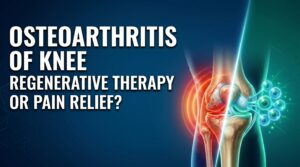
Osteoarthritis of the knee is a common problem after middle age. It may also occur earlier if there is any injury to the ligaments of the knee or the muscles that move it. The world prevalence is 10-20% with India reporting a higher prevalence of 20-39% probably because of lack of exercise, nutritional issues and obesity. Approximately 2.5 lakh knee replacement surgeries/year are performed in India alone out of the 6 lakh replacements across the world or approximately 1/3 of the total knee replacements across the globe are performed in India alone.
Understanding the Source of Pain in Osteoarthritis
In the last two decades, there has been a lot of research in this field which says that the pain from osteoarthritis comes from neuropathy involving the nerves that supply the knee joint and the muscles that move it. This provides an alternative understanding to the orthopaedic viewpoint that focuses on the knee joint alone, its replacement and even more specifically on the cartilage loss. However, cartilage of the knee or anywhere else in the body has no nerve supply nor any explanation of how its loss produces pain.
Hilton’s Law and Its Role in Knee Pain
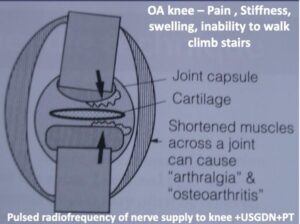
Osteoarthritis pain is better explained by Hilton’s Law, a physiological law, which states that there is a reciprocal innervation between the synovial membrane of the joint and the muscles that move the joint. In simple English, this means that the synovial membrane of the joint and the muscles that move it have a shared nerve supply that makes sure that the muscles move the joint optimally. The synovial membrane forms the inner most lining of the knee joint (that makes the joint surfaces silky smooth to glide without
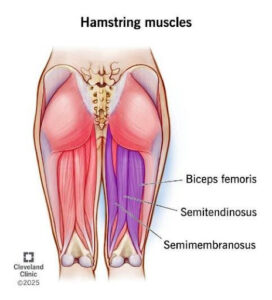
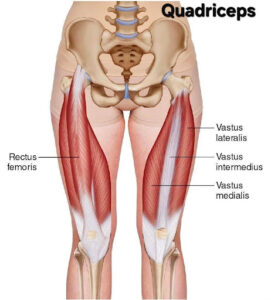
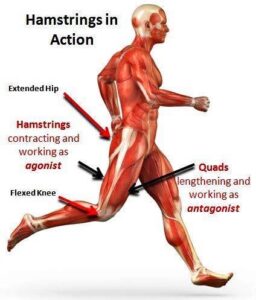
any friction), has a very rich nerve supply and is extremely sensitive, (much more than the bones or the cartilage, or even the ligaments). If the synovial membrane is irritated, then it causes an automatic spasm of the muscles around the joint. This is felt by the patients as a stiffness initially and later as Pain. In fact, the pain in osteoarthritis very closely follows anatomy of muscles particularly their insertion into bones adjacent to the joint.
Common Pain Patterns Seen in Osteoarthritis
The most common pain is just below or around the Patella, mainly due to quadriceps muscle spasm, and a mismatch between the power of hamstring muscles that flexes (bend) the knee and the quadriceps muscles that extend (straighten) the knee.
The next common Pain is on the inner part of calf mainly due to spasm of inner hamstring muscles at their insertion called the pes anserine tendon.
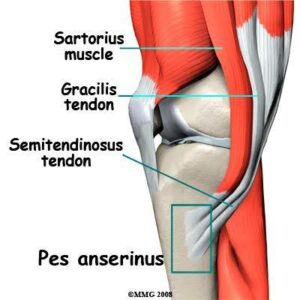
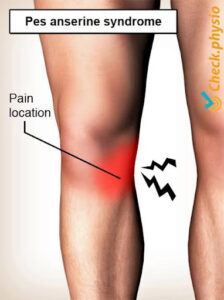
Some people also have inner thigh, muscle pains because of spasm of adductor muscles.
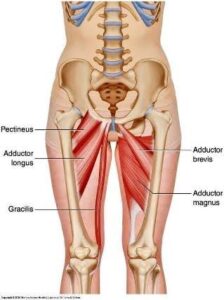
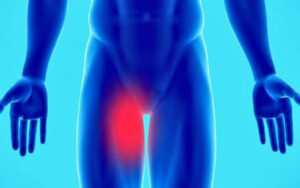
Some others have pain, the back of the knee or on the outer side of the knee. The back of knee pain might even present with a swelling called the Bakers cyst .
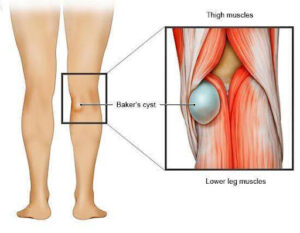
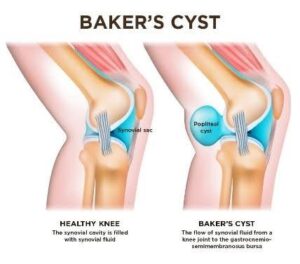
This is because of hamstring muscle spasm and is readily relieved by relaxing the hamstring muscles with ultrasound, guided, dry, needing. A few patients have pain on the outer knee because of a pain which comes not really from the knee joint. But from the Tibiofibular joint,
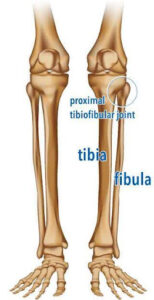
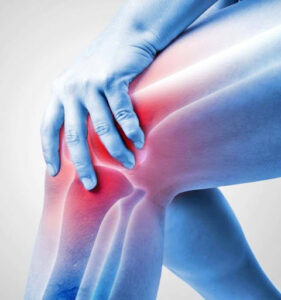
All these pains can be treated very well with a combination of PRF and ultrasound guided dry needling.
Why Knee Pain Worsens in Middle Age
In middle age, there are many changes, degenerative changes happening in the muscles and the joints all over the body and more in the knee a major weight bearing joint. The modern lifestyle of sitting in chairs instead of on the ground, avoidance of exercises or walking and active lifestyle general predispose to a weakening of muscles which leads to synovial changes and consequent stiffening of knee because of muscle pain spasm and shortening. Even daily activities of life begin to overload these muscles. These shortened muscles cause inflammation around the knee with its cardinal signs of swelling pain warmth and redness. All these are classical signs of osteoarthritis.
Ashirvad’s Novel Treatment Protocol
At Ashirvad we developed a novel treatment protocol to address the nerves that connect the synovium to the muscles and ultrasound guided, dry, needing to relax the muscles.The nerves involved are the entire nerve supply of the knee, including the nerves that supply the joint called genicular nerves. The nerve that supplies the muscles around the knee like quadriceps the hamstrings, the calf muscles, the adductor muscles, and also some other small muscles around the knee like sartorius , popliteus, peroneus et cetera.
Pulsed Radiofrequency (PRF) of Knee Nerves
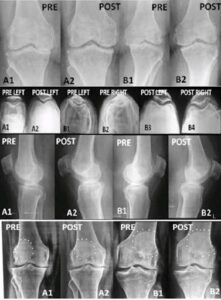
We developed the treatment called pulse radio frequency of the entire nerve supply of the knee, which includes the femoral nerve, (supplies quadriceps) sciatic nerve (supplies hamstrings, popliteus, calf and shin muscles) saphenous nerve (supplies sartorius, a notoriously painful muscle in OA knee) and in patients who have inner thigh pain the obturator nerve. There are three nerve plexuses the Peri Patellar, Sub sartorial and popliteal plexus which are also treated with PRF. Usually, after this PRF, we find that patients report 30 to 50% relief of their pain and stiffness and also the swelling within 2-3 days. We even find that the gap between the two bones’ femur and tibia widens after PRF to relieve the friction between the bones grinding and wearing out the cartilage.
Ultrasound-Guided Dry Needling (USGDN) After PRF
We start the ultrasound guided dry needling a week later. With this treatment patients are able to walk a lot more without pain and also climb stairs without pain. We usually ask the patient to start increasing their walking, standing and climbing steps gradually since these activities may cause some pain occur recurrence but the next session of ultrasound guided dry needing relieves this pain, allowing them to increase their functionality within a month or two. We have reported this as a publication in the international journal called Pain Physician. Hundreds of patients have benefited from this treatment since 2005 and live an active life. This is useful in patients in early and medium stages of osteoarthritis without too much joint damage.
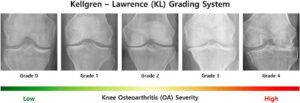
and in patients who are unfit for surgery and also in young patients, who would like to keep their own knees for some more years, and strengthen their knees before eventual knee replacement. We have also treated some patients with severe osteoarthritis who did not want to have surgery. We explained to them that their knee require surgery, but if they want to avoid surgery at any cost then we have helped them. In the past 20 years all such patients had good pain relief, but only 10 could not increase their activity and were advised to have surgery. Because the PRF and USGDN has already relieved the neuromyopathy of OA knee these patients could lead an active life after knee replacement.
This PRF followed by ultrasound guided dry needing is extremely useful, even in patients who suffer from persistent pains even after surgery of knee replacement. Nearly 21% patients continue to have pain in the first 6 months after surgery and about a7% have pain restricting their activity even later. We have published another article on the use of PRF and USGDN for relieving pain after knee replacement surgery In fact, this treatment was developed for many such patients who had failed to get pain relief after knee replacement and we later started using the technique to patients, with pain and distress from OA knee .